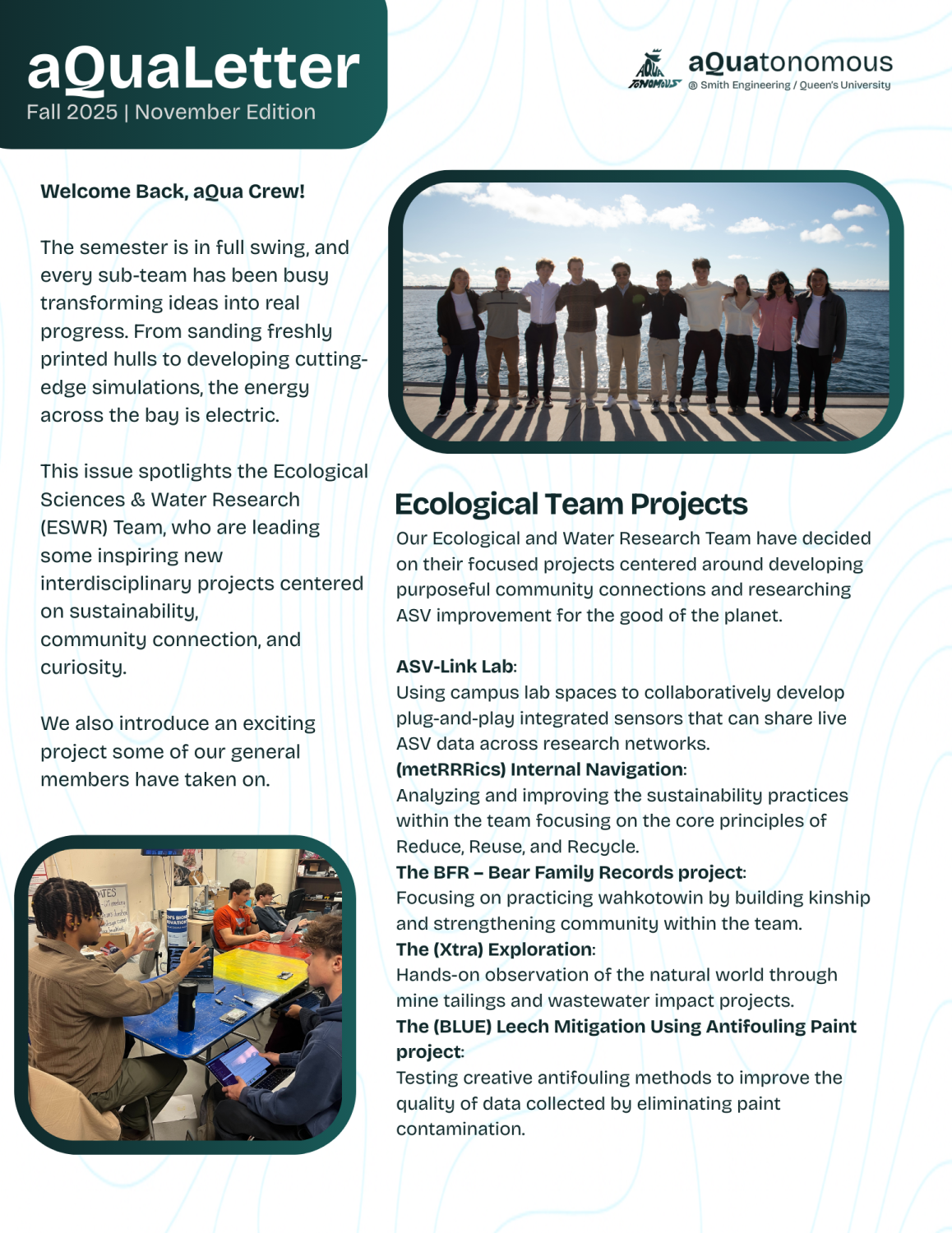
The semester is in full swing, and every sub-team has been busy transforming ideas into real progress. From sanding freshly printed hulls to developing cutting-edge simulations, the energy across the bay is electric.
This issue spotlights the Ecological Sciences and Water Research (ESWR) Team, who are leading some inspiring new interdisciplinary projects centred on sustainability, community connection, and curiosity.
We also introduce an exciting project some of our general members have taken on.
Our Ecological and Water Research Team have decided on their focused projects centred around developing purposeful community connections and researching ASV improvement for the good of the planet.
ASV-Link Lab:
Using campus lab spaces to collaboratively develop plug-and-play integrated sensors that can share live ASV data across research networks.
(metRRRics) Internal Navigation:
Analyzing and improving the sustainability practices within the team focusing on the core principles of Reduce, Reuse, and Recycle.
The BFR – Bear Family Records project:
Focusing on practicing wahkotowin by building kinship and strengthening community within the team.
The (Xtra) Exploration:
Hands-on observation of the natural world through mine tailings and wastewater impact projects.
The (BLUE) Leech Mitigation Using Antifouling Paint project:
Testing creative antifouling methods to improve the quality of data collected by eliminating paint contamination.
The Electrical team has made strong progress across multiple system components. Power distribution circuit diagrams have been finalized, while work continues on the transistor switching setup as different device options are bench tested. The current measurement circuit is under active development, supported by a custom-built bench testing rig, designed to improve data collection. Research is underway on a Wi-Fi bullet system to enable long-range communication between the on-board computer and the ground station. The Faraday caging plan is nearly finalized to reduce interference, which is essentially a protective enclosure that shields electronics from outside electromagnetic signals. The solar sub-team is actively researching optimal components for our ASV that allow for efficient clean energy extraction.
The Systems Integration team has successfully completed Mission Planner tuning and begun mentoring new members on their simulation technology. The Gazebo simulation workspace is now fully set up and operational, and the ASV model has been successfully built in the environment, with sensor and obstacle integration coming soon. The team is also actively researching GPS alternatives to support indoor testing environments. The systems integration team is working closely with Electrical, Mechanical, and Autonomy teams to ensure the design stays coherent.
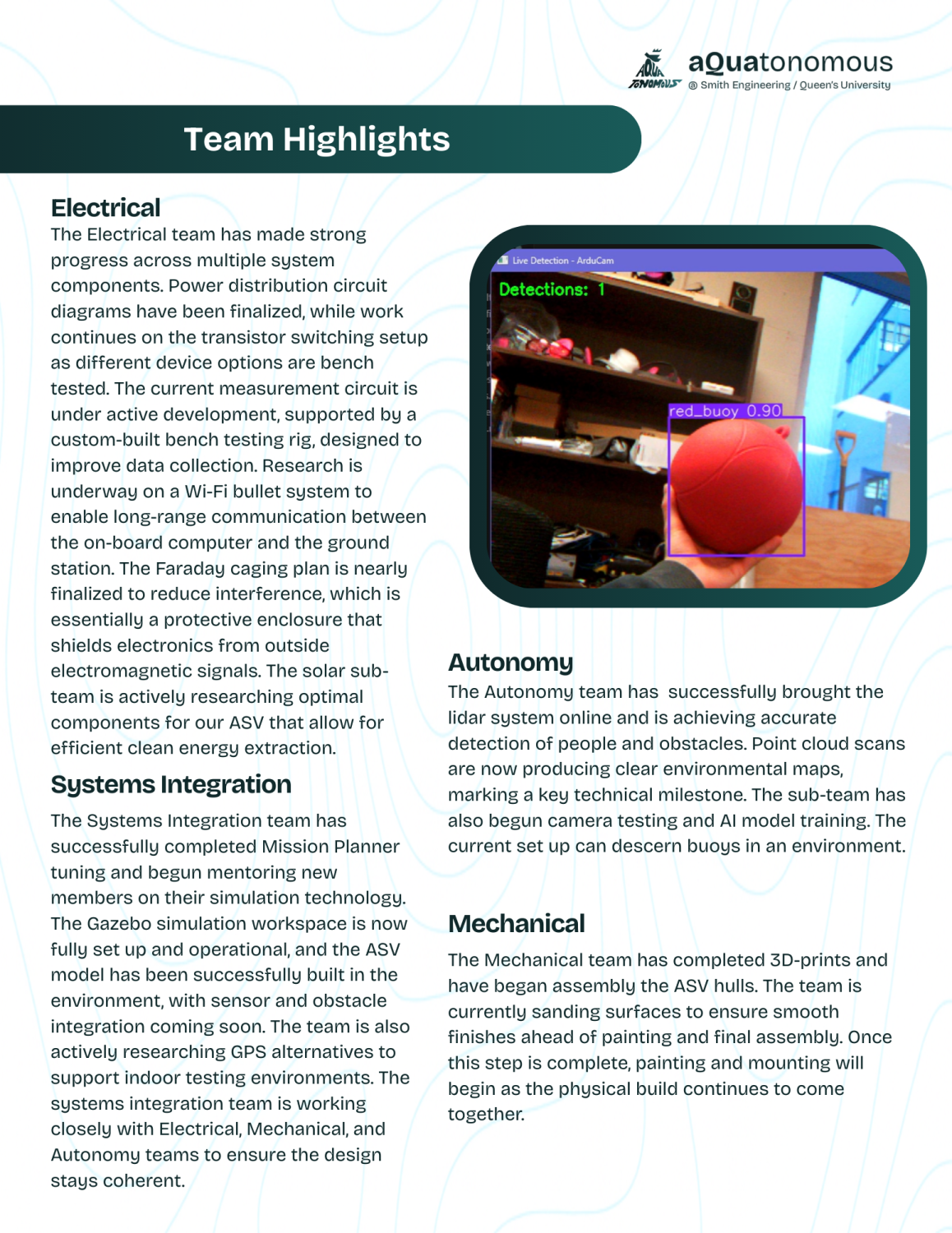
The Autonomy team has successfully brought the lidar system online and is achieving accurate detection of people and obstacles. Point cloud scans are now producing clear environmental maps, marking a key technical milestone. The sub-team has also begun camera testing and AI model training. The current set up can discern buoys in an environment.
The Mechanical team has completed 3D-prints and have began assembly the ASV hulls. The team is currently sanding surfaces to ensure smooth finishes ahead of painting and final assembly. Once this step is complete, painting and mounting will begin as the physical build continues to come together.
We wanted to show our appreciation for 4 individuals on our Electrical team who have taken on integrating solar-charging on board our ASV. Evan, Ali, Ryan, and Laura are developing an onboard solar-charging system to support the ASV’s high-load power requirements. This includes creating custom charging settings for the ASV batteries, implementing load control through the MPPT controller, and planning options for higher-current demands. Following this the team will select and mount solar panels and charge controllers to extend the vehicle’s time on the water to benefit both Research and Competition initiatives. This device provides a sustainable ground-station charging solution for when wall-outlet access is limited and eliminate the need for gas-powered alternatives. The team is currently finalizing panel choices and determining how best to integrate the system without disrupting telemetry.
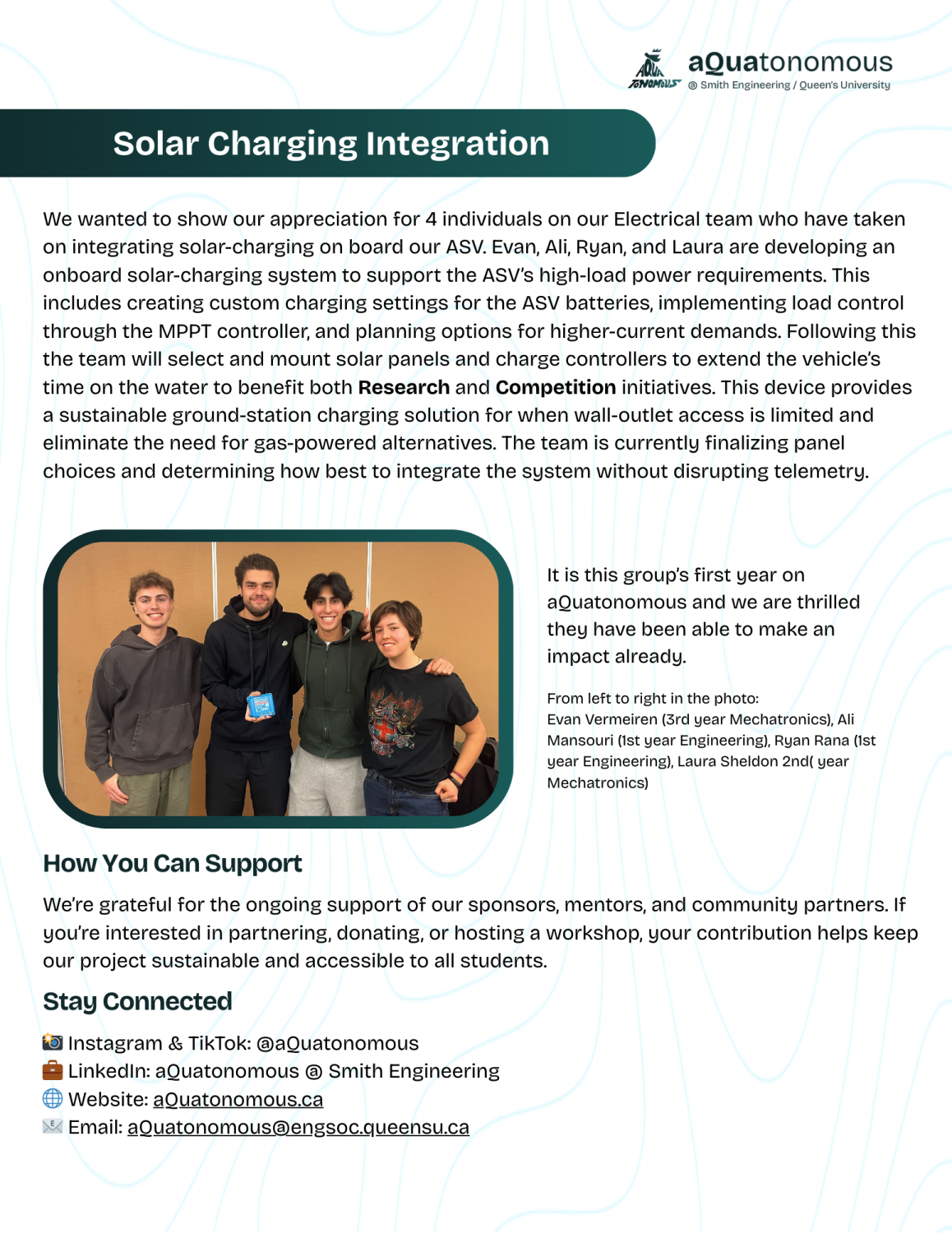
It is this group’s first year on aQuatonomous and we are thrilled they have been able to make an impact already.
From left to right in the photo:
Evan Vermeiren (3rd year Mechatronics), Ali Mansouri (1st year Engineering), Ryan Rana (1st year Engineering), Laura Sheldon (2nd year Mechatronics)
We’re grateful for the ongoing support of our sponsors, mentors, and community partners. If you’re interested in partnering, donating, or hosting a workshop, your contribution helps keep our project sustainable and accessible to all students.